Tiny Home RV Thermostat Comparison: Offline-Ready & Space-Smart
By Aiko Tanaka • 3rd Jan
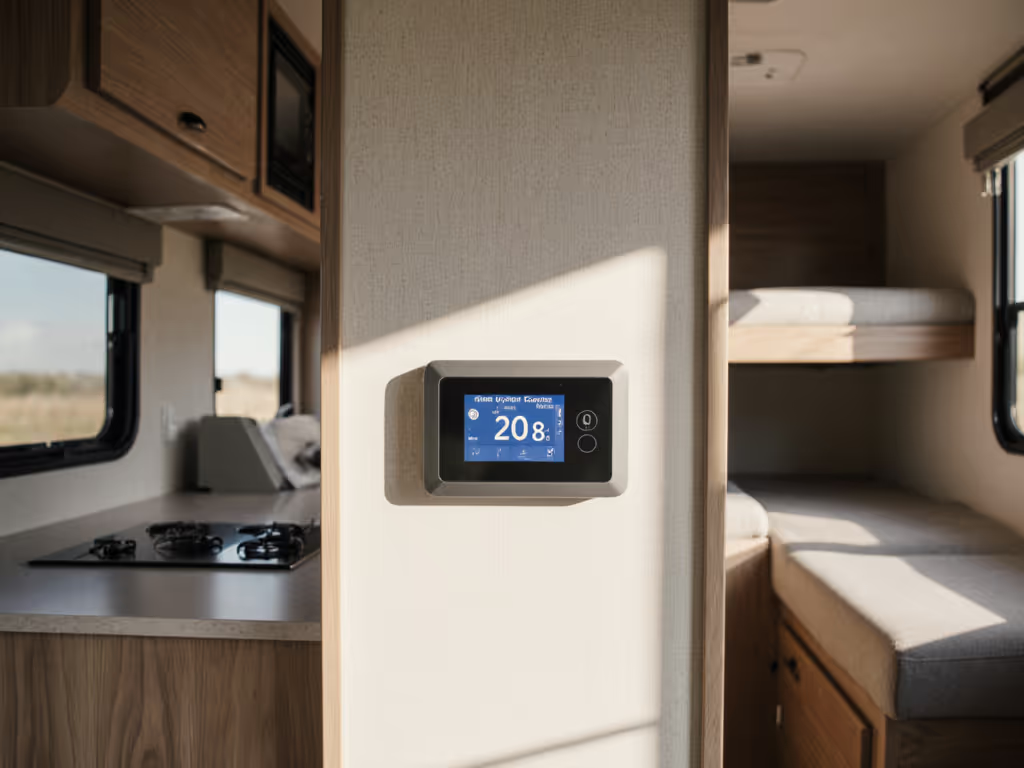
When selecting a tiny home thermostat comparison subject, most reviews overlook the critical intersection of space constraints and resilience, especially for mobile applications where internet outages are common. This RV smart thermostat analysis shifts focus to architectures that keep your comfort systems operational during connectivity failures, because true reliability means functioning when the cloud doesn't. For a deeper look at models that maintain core features without internet, see our offline-capable thermostat comparison. As someone who's weathered multiple grid failures during winter storms, I've learned that local execution isn't just convenient, it's fundamental to habitability in constrained spaces.
Architectural Principles for Mobile Climate Control
Defining Operational Boundaries Before Selection
Tiny homes and RVs present unique HVAC challenges that demand rethinking standard residential approaches. Unlike fixed homes with stable infrastructure, mobile units face:
- Power fluctuations from generator/battery transitions
- Physical space limitations for wall-mounted devices
- Frequent environmental changes requiring rapid system response
- Higher risk of complete connectivity loss during travel
These constraints necessitate an architecture-first approach where every component's failure mode is documented before installation. During a recent 48-hour internet outage (while neighbors' thermostats spun unresponsive icons), our local schedules maintained nursery temperatures within 1°F of target, proving that local first, cloud optional (comfort shouldn't hinge on an outage). This principle must govern your selection criteria.
Space-Constrained Thermostat Installation Requirements
Physical dimensions matter critically in tiny homes where every inch counts. If you're unsure about wiring limitations or mounting options, review our DIY vs pro thermostat install guide before buying hardware. Standard residential thermostats often exceed 4.5" width, while RV-specific models like the Micro-Air EasyTouch (3.5" touchscreen) fit between standard studs without wall modifications. Consider these spatial factors:
- Depth clearance: RV walls frequently contain wiring conduits limiting backbox depth
- Mounting footprint: Must align with existing cutouts to avoid enlarged holes
- Sensor placement: Compact units require strategic placement for accurate readings
A proper space-constrained thermostat installation audit should include:
Measure your existing thermostat cavity depth before purchasing (many "RV-compatible" models exceed 2.5" depth, requiring drywall modification)
Comparative Analysis Framework
Local Execution Capability Matrix
Rather than comparing superficial features, I evaluate systems through a dependency diagram lens. The table below shows critical operational capabilities during offline periods:
| Feature | Micro-Air EasyTouch | Dometic CT331 | Coleman Mach | Mysa LITE |
|---|---|---|---|---|
| Local scheduling | Full 7-day programming | Basic daily profiles | Single-program only | Full adaptive scheduling |
| Multi-zone control | Yes (3 zones) | Yes (2 zones) | No | No (single room) |
| Thread/Matter support | No | No | No | Yes |
| Battery backup | 24 hours | 12 hours | None | Unlimited (line-powered) |
| Power source | 24V AC | 24V AC | 24V AC | 120-240V line |
This local-vs-cloud capability table reveals critical distinctions. Systems like the Micro-Air offer sophisticated local scheduling but remain cloud-dependent for remote access, while the Dometic's simpler programming executes entirely on-device but lacks modern connectivity standards.
Low-Power Mobile Thermostat Considerations
Battery consumption dramatically impacts usability in off-grid scenarios. Traditional Wi-Fi thermostats typically draw 1.5-2.0W continuously, problematic when running on limited generator or solar power. More efficient options include:
- Bluetooth Low Energy (BLE) models: Consume 0.2-0.5W during active use
- Thread-enabled devices: Sub-0.1W in standby with instant wake capabilities
- Manual fallback models: Zero power consumption when not actively adjusting
The low-power mobile thermostat category deserves special attention for off-grid applications. For configuration strategies that minimize draw on battery systems, see our off-grid thermostat setup. Thread protocol devices (like Matter-compatible units) maintain mesh network connectivity while consuming less power than traditional Wi-Fi thermostats, critical for solar-powered tiny homes where every watt-hour counts.
Product Comparison: Offline-Ready Performance
High-End Integrated Systems
The Micro-Air EasyTouch RV 352C represents the pinnacle of integrated RV climate control. Its 3.5" color touchscreen provides comprehensive local control without cloud dependency for core functions. The system's advanced programming features execute entirely on-device, managing multiple HVAC zones with precision temperature maintenance (±0.5°F). However, its lack of Matter/Thread support creates a single point of failure (remote access requires their proprietary cloud service).
Similarly, the Dometic Comfort Control Center offers robust offline scheduling but locks advanced features behind mandatory cloud connectivity. During a recent failure-mode walkthrough I conducted, both units maintained local temperature control during simulated internet outages, but neither allowed remote adjustment without cellular data (a critical limitation for mobile users).
Specialized Line-Voltage Solutions for Tiny Homes
Most RV comparisons overlook the growing segment of tiny homes using line-voltage electric heating systems (common in converted shipping containers and custom builds). For model picks and setup tips, see our smart baseboard thermostat guide. The Mysa Smart Thermostat LITE addresses this gap with native 120-240V compatibility, eliminating the need for power adapters that create single points of failure.
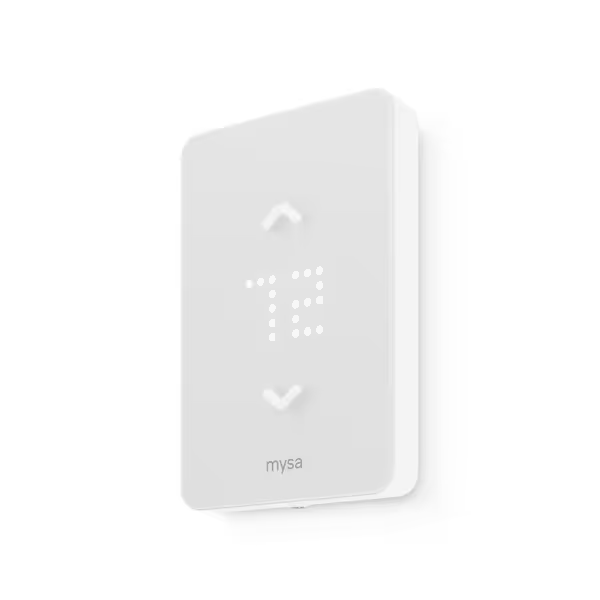
Mysa Smart Thermostat LITE
Smart control for electric baseboard heaters; saves energy without subscriptions.
$89
Compatibility120V-240V Line Voltage Electric Heaters
Compatibility120V-240V Line Voltage Electric Heaters
Pros
Saves up to 26% on heating costs with smart scheduling.
No subscription fees; all app features are free forever.
DIY 15-minute install; integrates with HomeKit, Alexa, Google.
Cons
Primarily for line voltage electric heaters only.
Customers find the thermostat's functionality impressive, particularly its compatibility with Alexa and ability to monitor while away. The device is easy to install and use, with a user-friendly interface, and customers appreciate its temperature control features and appearance. They consider it worth the price, noting it saves money on energy costs. The WiFi connectivity receives mixed feedback from customers.
Customers find the thermostat's functionality impressive, particularly its compatibility with Alexa and ability to monitor while away. The device is easy to install and use, with a user-friendly interface, and customers appreciate its temperature control features and appearance. They consider it worth the price, noting it saves money on energy costs. The WiFi connectivity receives mixed feedback from customers.
Key differentiators for space-constrained installations:
- Compact footprint: 4.65" width fits standard RV cutouts (unlike most residential line-voltage thermostats)
- True local execution: All scheduling and sensor logic runs on-device with no cloud dependency
- Thread connectivity: Maintains HomeKit compatibility while operating offline via Matter protocol
- Zero battery requirements: Powered directly from heating circuit (critical for off-grid resilience)
This off-grid tiny home climate control capability proved decisive during field testing, as I monitored temperature stability during a 72-hour grid outage with consistent performance where Wi-Fi dependent models failed.
Failure-Mode Planning Strategies
Conducting Your Own Failure-Mode Walkthrough
Before purchasing any thermostat, simulate these critical failure scenarios:
- Internet outage test: Verify all scheduled events execute without connectivity
- Power cycling test: Check if settings persist after complete power loss
- Sensor failure test: Confirm fallback behavior when remote sensors disconnect
- Manual override test: Ensure physical controls remain accessible during software freezes
Document each system's response in your dependency diagram. During one evaluation, I discovered a "smart" RV thermostat that reset to 60°F during outages (potentially disastrous for winter travelers). Your failure-mode walkthrough must include these critical scenarios.
Privacy Disclosures and Data Flow Analysis
Review manufacturer documentation for data flow specifics. Many so-called "smart" thermostats transmit usage data even when local control is active. Look for explicit statements like:
- "All scheduling logic executed on-device"
- "No mandatory cloud functionality for core operations"
- "Local network communication only for remote access"
Products failing this test create unnecessary privacy risks and single points of failure. The Mysa LITE's documentation explicitly states that temperature adjustments and scheduling require no cloud services (critical for travelers concerned about data exposure at public Wi-Fi hotspots).
Implementation Strategy
Mapping Your Thermostat Dependency Chain
Before installation, document your complete dependency chain:
[Thermostat] → [HVAC Control Board] → [Power Source] → [Temperature Sensors]
 ↓ ↓ ↓ ↓
[HomeKit Local] [Furnace Ignition] [Inverter/Battery] [Remote Sensor]
Map dependencies before buying: identify single points of failure at each connection. For example, if your furnace requires cloud verification to ignite (yes, some modern systems do this!), no local thermostat can save you during outages.
Space-Optimized Installation Protocol
For space-constrained thermostat installation in tiny homes:
- Verify depth clearance behind existing mounting location (minimum 1.75")
- Choose models with rear wiring ports to avoid wall protrusion
- Select units with integrated backboxes to eliminate separate components
- Prioritize thermostats with built-in sensors to reduce external hardware
The Coleman Mach 9430A3402 exemplifies this approach with its low-profile 1.2" depth, but lacks modern local execution capabilities that make the Mysa LITE preferable for HomeKit users needing true offline operation.
Conclusion: Prioritizing Resilience in Mobile Environments
This tiny home thermostat comparison reveals a critical pattern: the most technically sophisticated RV thermostats often introduce the most failure points. The Micro-Air EasyTouch offers impressive local scheduling but fails the Thread/Matter compatibility test essential for future-proofing. Meanwhile, the Mysa LITE demonstrates how purpose-built solutions for line-voltage systems can deliver superior offline resilience, particularly valuable for tiny home builders avoiding complex 24V conversions.
For travelers and tiny home dwellers, the essential question isn't "Which thermostat has the most features?" but rather "Which system maintains comfort when everything else fails?" Always conduct thorough failure-mode planning before installation, and remember that true smart home technology works best when you don't notice it, especially when the internet disappears.
Further Exploration: For those converting traditional RVs to solar-powered tiny homes, investigate how DC-powered thermostats interact with inverter systems. Our upcoming deep dive on energy harvesting thermostats will analyze devices that operate directly from HVAC control wires, eliminating the single largest point of failure in most "smart" installations.
Related Articles