VRF Thermostat Compatibility: What Works
By Priya Nandakumar • 2nd May
Introduction
VRF thermostat compatibility and choosing the right variable refrigerant flow thermostat for your system is far more nuanced than matching a popular smart model to any equipment. Variable refrigerant flow systems (whether branded as VRF or VRV, which stands for Variable Refrigerant Volume) operate on fundamentally different control logic than traditional forced-air systems. Unlike a single furnace plus AC setup, VRF systems manage multiple indoor units, complex refrigerant distribution, and zone-specific staging, which means most mainstream thermostats lack the wiring and protocol support these systems demand. This article clarifies which thermostats actually work with VRF, what compatibility truly means, and how to avoid costly mistakes during installation.
FAQ: VRF Thermostat Compatibility Essentials
What is VRF, and why does it need a special thermostat?
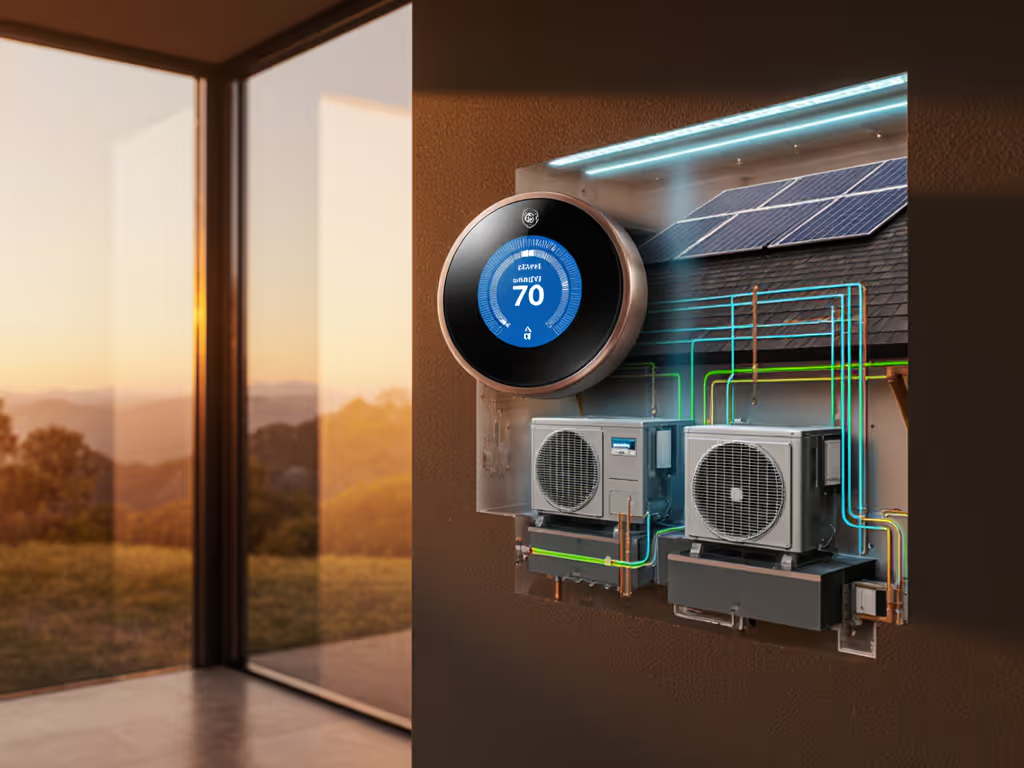
Variable refrigerant flow systems circulate refrigerant directly from an outdoor condenser to multiple indoor air handlers or fan coils, with no central furnace or air handler. Each zone has its own evaporator coil and fan, and the outdoor unit modulates refrigerant flow based on real-time demand from all zones. This is fundamentally different from a traditional system where one central air handler serves the whole house.
Why standard thermostats fail: Most consumer-grade smart thermostats (including many popular WiFi models) are wired for single-zone systems with discrete on/off or two-stage compressor control. They expect a C-wire (common), a Y terminal for cooling, W for heating, and G for the fan. VRF systems require multi-zone control logic with constant feedback to the outdoor unit about each zone's demand, setpoint, and occupancy status. Without this feedback pathway, a standard thermostat cannot communicate the nuanced staging the VRF condenser needs to operate efficiently (or at all).
Compatibility means the thermostat's protocol, wiring, and control strategy must align with your VRF architecture.
What wiring does a VRF system expect from the thermostat?
VRF thermostats typically use one of three control architectures:
1. Proprietary RF or hardwired bus (Daikin, Fujitsu, LG, Mitsubishi)
- Each zone unit or zone panel communicates with the outdoor condenser over a dedicated low-voltage bus (often a two- or three-wire connection).
- The thermostat for each zone is integrated into the indoor unit's control module or a separate remote control that speaks the manufacturer's proprietary protocol.
- Standard 24V thermostat wiring (R, C, Y, W, G) is rarely relevant.
2. BACnet/Modbus gateway with standard 24V zones
- Some commercial or higher-end VRF systems use a building management system (BMS) or gateway device to translate standard thermostat signals into VRF-native commands.
- In this case, each zone thermostat appears to use traditional wiring (R, C, Y, W, G), but it is bridged through a control module.
3. Web-based or cloud-integrated hubs (rare for residential)
- Newer mini-split systems with WiFi capability sometimes offer a central hub that accepts thermostat input via WiFi or Zigbee rather than hardwired terminals.
Risk flag: If you are unsure which architecture your VRF system uses, power off at the breaker; label wires before you touch anything. Take high-resolution photos of the zone panel, outdoor unit control board, and any existing thermostat or remote control. Confirm with the installer's documentation or the manufacturer before purchasing a replacement.
Can I use a smart thermostat like Nest or Ecobee with my VRF system?
Short answer: Almost never without an adapter or control bridge, and even then, not safely.
These thermostats are optimized for single-zone, two-stage systems (furnace + AC or heat pump). They cannot natively speak VRF protocols like Daikin's proprietary bus or Mitsubishi's adaptive control language. Installing one in place of a zone thermostat on a VRF system will likely result in:
- No heating or cooling (the zone unit receives no valid command signal).
- Short-cycling of the outdoor compressor (if the thermostat outputs a generic Y signal, the condenser may ramp up and down unpredictably).
- Loss of occupancy and staging logic that the VRF system uses to optimize efficiency across multiple zones.
I have encountered multi-unit jobs where a homeowner upgraded one zone's thermostat to a popular smart model without checking compatibility. On a service call, we discovered the W2 terminal on the zone panel had been tied into an auxiliary heat output on the smart thermostat, causing short-cycling of the backup heat. We photographed the board, labeled each conductor, and corrected the wiring with proper logic and an outdoor sensor. Heat stabilized, but the lesson was unmistakable: compatibility and safety come before features and aesthetics.
Exception: Some VRF system installers offer a proprietary WiFi bridge or adapter that translates commands from a standard thermostat API (like Google Home or Amazon Alexa) into valid VRF bus commands. This is safe only if the adapter is approved by the VRF manufacturer and installed by a licensed technician who verifies proper staging and compressor protection. Do not proceed without that verification.
What are the main VRF manufacturers, and what thermostats do they recommend?
Daikin
- Native control: Daikin zone thermostats or the Daikin app (via compatible WiFi control module).
- Multi-zone support: Yes; system supports 2-32 zones depending on model.
- Standard thermostat compatibility: Limited. Daikin's proprietary communications (particularly on older models) do not integrate natively with Nest, Ecobee, or Honeywell smart thermostats.
- Note: Newer Daikin commercial systems with BACnet gateways can sometimes bridge to standard thermostats, but this requires commissioning and is rare in residential settings.
Mitsubishi Electric
- Native control: Mitsubishi-branded zone thermostats, remote controls, or their My Mitsubishi app (requires compatible outdoor unit and indoor modules).
- Multi-zone support: Yes; up to 8-16 zones depending on refrigerant circuit architecture.
- Standard thermostat compatibility: No native support for Nest, Ecobee, or other mainstream smart thermostats. Mitsubishi does not publish a public API for third-party thermostat integration.
- Note: System requires a dedicated control module (e.g., PAC-USWH002D-1 or newer) to enable remote control; thermostats are not interchangeable.
Fujitsu
- Native control: Fujitsu zone controllers or the Fujitsu app (via compatible WiFi adapter).
- Multi-zone support: Yes; up to 24 zones on some commercial models.
- Standard thermostat compatibility: No direct integration with consumer smart thermostats.
- Note: Some commercial Fujitsu systems use BACnet, which may allow adapter-based integration, but this is not commonly supported for residential installs.
LG Multi V / LG VRF
- Native control: LG ThinQ app, compatible LG zone controllers, or compatible gateway devices.
- Multi-zone support: Yes; varies by model.
- Standard thermostat compatibility: Limited. LG systems are moving toward cloud-based control and API expansion, but mainstream thermostat integration remains proprietary.
Carrier / Trane (Commercial VRF focus, less common residential)
- Native control: Proprietary zone thermostats or BMS integration.
- Multi-zone support: Yes.
- Standard thermostat compatibility: Typically via BACnet gateway only; requires commercial licensing and commissioning.
Bottom line: If your VRF system is from Daikin, Mitsubishi, Fujitsu, or LG, document your wiring before removal by photographing the zone panel and any existing thermostat or controller. Then verify compatibility with the manufacturer's tech support or a licensed installer. Do not assume a popular smart thermostat will work.
What should I look for in a VRF-compatible thermostat?
If your system's manufacturer does offer a proprietary or third-party compatible thermostat or control bridge, prioritize these features:
1. Multi-zone awareness
- The thermostat should display and control each zone's setpoint independently or via a companion app.
- It must support occupancy detection per zone (or globally override all zones).
2. Staging and compressor protection
- It should enforce minimum off-time between compressor cycles to protect the outdoor unit's motor.
- It must prevent simultaneous heating and cooling demands (for example, Zone A heating while Zone B cools) unless the system supports simultaneous operation on separate circuits.
3. Reversing valve logic (O/B polarity)
- If the system includes heating and cooling, the thermostat must correctly command the refrigerant flow direction (defrost for heating in cold climates, or heat recovery VRF thermostat logic from cooling zones).
- Incorrect polarity will freeze the outdoor coil or overheat the system.
4. Auxiliary heat control (if dual-fuel backup exists)
- If your VRF system has a backup furnace or electric resistance heating, the thermostat must prevent auxiliary heat from running during refrigerant heating mode (to save energy).
- It must also set a lockout threshold (for example, auxiliary heat only below 35°F outdoor temperature) to avoid short-cycling the backup heat.
5. Local override and manual fallback
- Even if the thermostat is cloud-connected, it should allow manual setpoint adjustment and on/off control without internet.
- It must default to a safe state (maintain current temperature) if WiFi or cloud service fails.
6. Demand response readiness
- If you are enrolled in a utility demand response program, the thermostat should accept commands to shift setpoints temporarily without permanently disabling heating or cooling.
What if my VRF system does not have a compatible modern thermostat?
Several retrofit paths exist, each with trade-offs:
Option 1: Stick with the manufacturer's thermostat or remote control
- Pros: Guaranteed compatibility; no risk of short-cycling or staging errors.
- Cons: Limited smart home integration; may lack WiFi, occupancy learning, or scheduling beyond basic timers.
Option 2: Install a BACnet or Modbus bridge (commercial approach)
- Pros: Allows integration with building automation systems and some third-party thermostats.
- Cons: Requires commissioning; expensive ($2,000-$5,000 labor + equipment); may void some manufacturer warranties; not available for all residential VRF models.
Option 3: Use the manufacturer's proprietary app or WiFi control module (if available)
- Pros: Enables remote control and some scheduling via smartphone.
- Cons: App may be less intuitive than competitors; privacy and data policies vary; dependent on the manufacturer's cloud infrastructure and ongoing software support.
Option 4: Install a universal IR blaster or gateway (only for systems with IR remote controls)
- Pros: Allows voice control and scene automation via Alexa, Google Assistant, or Apple Siri (if a compatible bridge exists).
- Cons: Not officially supported by most VRF manufacturers; relies on learned IR commands, which may be unreliable; does not satisfy staging, compressor protection, or wiring integrity. Only use if absolutely no other option exists.
If you pursue any retrofit, involve a licensed HVAC technician to verify staging logic, compressor protection timers, and staging limits before declaring the system safe.
What about mini-splits and multi-head systems - are they the same as VRF?
Technically, no, but often related.
A mini-split is a single-zone ductless system (one outdoor condenser, one indoor air handler) with its own wireless remote control. Many mini-splits use the same refrigerant modulation technology as VRF but lack the multi-zone VRF control orchestration. A multi-head system (also called multi-split or mini-multi) has one outdoor condenser serving 2-4 indoor units, but each indoor unit is controlled independently by its own wireless remote. They are not full VRF because the outdoor condenser does not perform real-time multi-zone demand staging. Each zone demands cooling or heating separately, and the condenser responds one zone at a time, which can waste energy.
Thermostat implications:
- Mini-splits rarely have traditional hardwired thermostat control. Instead, they use wireless remotes or a manufacturer-provided app.
- Popular smart thermostats do not support mini-splits natively.
- Workaround: Some homeowners use an IR blaster (for example, a smart home hub with IR capability) to learn and replay the remote's codes, enabling voice control. However, this typically provides only on/off and basic temperature setpoint commands, not scheduling or robust occupancy automation.
Risk flag: If you are considering a mini-split or multi-head system and want smart home integration, confirm before purchase whether the manufacturer offers a WiFi-enabled control module or gateway. Do not assume a standard thermostat or IR bridge will work safely.
How do I know if a thermostat is the best HVAC thermostat for my specific VRF setup?
The answer depends on your exact equipment, zone count, and desired features. A thermostat is best only if it is officially supported by your VRF manufacturer and verified by a licensed technician. Generic reviews or marketing claims about "best" are less relevant than compatibility confirmation.
Use this checklist:
- Manufacturer approval: Is the thermostat listed in your VRF system's compatible device documentation?
- Wiring verification: Have you photographed your current thermostat wiring and confirmed the new model's wiring matches?
- Staging logic: Does the thermostat enforce compressor-off time and avoid simultaneous heating/cooling in conflicting zones?
- VRV system compatibility (if VRV-branded): Is it explicitly tested with your specific outdoor and indoor unit models?
- Technician sign-off: Has a licensed HVAC professional verified the install and tested runtime for at least 48 hours?
If all five are confirmed, that thermostat is the best choice for your home, regardless of brand prestige or smart home features.
Actionable Next Steps
Step 1: Identify your system type and manufacturer.
- Check the outdoor unit's nameplate and any existing thermostat or control panel.
- Photograph the zone panel, outdoor unit board, and wiring.
- Locate the original installation manual or contact the installer.
Step 2: Contact the VRF manufacturer's technical support or your licensed installer.
- Ask explicitly: "What thermostats or control devices are officially compatible with my model?"
- Request documentation for staging logic, compressor protection, and wiring.
- Ask whether they support third-party integration (BACnet, Modbus, API, etc.).
Step 3: Evaluate your smart home platform priorities.
- If you are committed to HomeKit, Google Home, or Alexa, confirm whether the VRF manufacturer offers an approved bridge or adapter.
- Accept that native integration may not exist, and that is acceptable if the manufacturer's app meets your scheduling and remote-control needs.
Step 4: Assemble your thermostat upgrade toolkit (if proceeding).
- Screwdriver set (Phillips and flathead)
- Wire strippers (18-24 gauge)
- Electrical tape
- Label maker or masking tape and marker
- Digital multimeter (to verify 24V power before and after install)
- Smartphone with camera (for documentation)
- Manufacturer's wiring diagram and compatibility checklist
Step 5: Plan a test install (if upgrading an existing zone thermostat).
- Power off at the breaker; label wires before you touch anything.
- Document your wiring before removal with photos of wire colors, terminal labels, and any zone control board.
- Install only if the new thermostat is officially approved by the VRF manufacturer.
- Verify compressor runtime, cycling time, and zone setpoints for 48 hours before declaring it successful.
Step 6: If retrofit compatibility is uncertain, hire a licensed HVAC technician.
- Cost: typically $150-$300 for a diagnostic visit and wiring verification.
- Benefit: Avoids risk of short-cycling, staging failures, or control board damage. For a clear breakdown of when DIY makes sense and when to call a pro, see our DIY vs pro wiring guide.
- Worth it if you are replacing or adding thermostats to a complex multi-zone VRF control system.
--
The key principle: Compatibility and safety come before features and aesthetics. VRF systems are sophisticated and expensive; a misstep with thermostat selection or wiring can disable a zone, trigger nuisance cycling, or void your warranty. Take time to verify compatibility, document your wiring, and involve a licensed professional if you are unsure. The confidence of a correctly functioning multi-zone system is worth the upfront diligence.
Related Articles